Who Are the Jaats? Why We’re Proud to Be Jaat
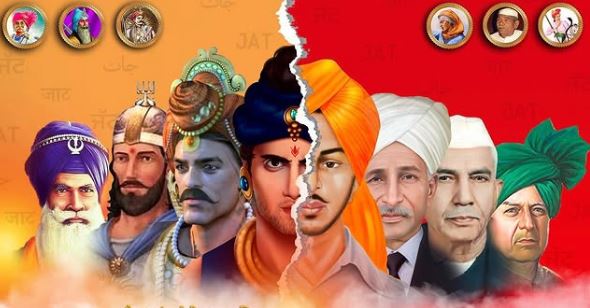
Being born into a Jaat family doesn’t just give you a surname — it hands you a legacy. A legacy that’s not built on paper, but on soil, sacrifice, and sheer strength of character.
And yet, when someone asks “Who are the Jaats?”, it’s not a question of caste — it’s a question of code. A way of life. A mindset. One built on simplicity, sincerity, and a deep sense of self-worth.
In fact, we live by a phrase that captures our spirit in just a few words:
“Jo baat ka nahi, wo Jaat ka nahi.”
This isn’t just a saying. It’s a lens — and through it, you start to understand how history shaped us.
Strength Rooted in History: Warriors, Kings, and Legends
That code of honor, that demand for accountability — it didn’t come from nowhere. It was forged in fires of resistance, rebellion, and responsibility.
And nowhere is that more visible than in our history.
From the battlefield of Bharatpur to the gates of Delhi, Jaats didn’t just witness history — they wrote it. Not with ink, but with action.
Take Maharaja Suraj Mal, for example. He didn’t just rule; he unified. Known for military brilliance and economic foresight, he proved that a Jaat’s strength isn’t just in arms, but in administration.
Or Baba Baghel Singh, who led Jat Sikh forces to capture Delhi in 1783. That moment is remembered even today as “Jaat Delhi Fateh.” It wasn’t just a battle won; it was a message sent — we’re not to be ignored.
But what ties all these figures together — from Harphool Jat to Hoshiar Singh Dahiya — is this: they acted when others hesitated. And that action wasn't for greed, but for honor.
That same sense of action still drives us — just that now, the battlefield may have changed.
Social Contribution: From Fighters to Builders
The sword has evolved into the spade, the pen, and the startup pitch. And the Jaat didn’t resist that change — we adapted.
What history taught us — to take responsibility, to protect, to lead — we carried forward into society.
Traditionally, we’ve been farmers — the providers of India. But when it was time to grow, we didn’t limit ourselves to land. We moved into civil services, defense, education, and now even technology and global business.
So when someone today sees a Jaat as just a “rural warrior,” they miss the full picture. Because now, we’re:
-
Defending borders as soldiers
-
Running companies as founders
-
Leading reforms as civil servants
-
Educating youth as professors and social activists
And we do all this while still holding the same values that once led our ancestors into battle. The battlefield has changed — but the battles of principle remain the same.
The Psychology of a Jaat: Loyalty, Logic, and Leadership
Those principles run deep — and they form the emotional and behavioral architecture of every Jaat, regardless of where he or she is today.
The same values that made us warriors in the past now make us leaders, problem-solvers, and collaborators in every professional setting.
- We’re loyal — but not blind.
- We’re fearless — but not reckless.
- We’re direct — because we believe truth isn’t optional.
This is why, even in the corporate world, people notice something distinct in a Jaat’s working style. We don't sugarcoat. We commit. We don't sit idle in confusion — we ask, we act, we deliver.
And this mindset becomes even more powerful when paired with modern education and global exposure. It gives us an edge — one rooted not in entitlement, but in clarity.
That clarity comes from a culture that never feared authority — and that never feared accountability either.
Cultural Values That Don’t Expire — They Evolve
Even as the world becomes more complex, our core values remain timeless. And perhaps what’s most fascinating is this:
We’re not trying to “preserve” the Jaat identity in glass.
We’re living it — adapting it to new challenges, without compromising its essence.
Our culture teaches us to speak up, not conform.
To earn respect, not demand it.
To give, even when we don’t have much.
To protect our people, our word, and our work — no matter the odds.
That’s why we often get misunderstood. People mistake our directness for arrogance. Our pride for ego. Our silence for ignorance.
But ask anyone who has worked closely with a Jaat — and they’ll tell you: once you have our trust, you’ve got something unbreakable.
The Modern Jaat: Tradition Meets Transformation
As a Jaat professional working in tech and data science, I often find myself translating these deep-rooted traits into something modern, useful, and strategic.
Whether I’m talking to a web team, sales team, support engineers, QA testers, or business stakeholders — what really helps isn’t just degrees or tools. It’s the mindset.
The clarity to speak the truth.
The responsibility to own a problem.
The resilience to stay till it’s solved.
The loyalty to the mission and the team.
And yes, I’ve faced interviews where they said:
"You don’t have domain knowledge."
But I say this — domain knowledge is acquirable.
But clarity, logic, commitment — either you have it or you don’t.
So instead of asking “Does he know the industry?”, maybe we should ask:
“Can he analyze, articulate, and deliver?”
Because when you get a true Jaat in your team — you don’t just get a worker.
You get a pillar.
Final Thoughts: Why I’m Proud to Be a Jaat
I’m proud of being a Jaat not because of caste. But because of character. Because this identity teaches me:
-
To stay grounded, but not small.
-
To fight battles that matter.
-
To walk away from lies, not truths.
-
To honor effort more than outcome.
-
To be the one who stands when others hesitate.
Our history may be old, but our relevance is eternal.
We were never just another community.
We were — and still are — a mindset.
So the next time someone asks, "Who are the Jaats?", just tell them:
We’re the ones who don't quit.
We’re the ones who don’t fake.
We’re the ones who stand — even when it’s not easy.
That’s not pride. That’s just the truth.
And in our language, truth and pride… are the same thing.